

Your content in Scripe is only as strong as the knowledge you feed it. Every post, draft, or suggestion generated by Scripe relies on the accuracy and richness of your Knowledge Base. Scripe offers two types of Knowledge Bases:Documentation Index
Fetch the complete documentation index at: https://docs.scripe.io/llms.txt
Use this file to discover all available pages before exploring further.
- Company Knowledge Base: Content uploaded here is applied to ALL personal brands in your workspace. Ideal for brand guidelines, company case studies, or shared playbooks.
- Personal Brand Knowledge Base: Content uploaded here is ONLY used for your brand. Keep all your individual notes, stories, and inputs here for brand-authentic content.
Types of Content Sources in the Knowledge Base
Scripe’s Knowledge Base is your central library for all the material you want Scripe to use when creating content. To add something to the Knowledge Base, simply click on+ New Content Source.
Here are all the types of Content Sources you can add to your Knowledge Base in Scripe:
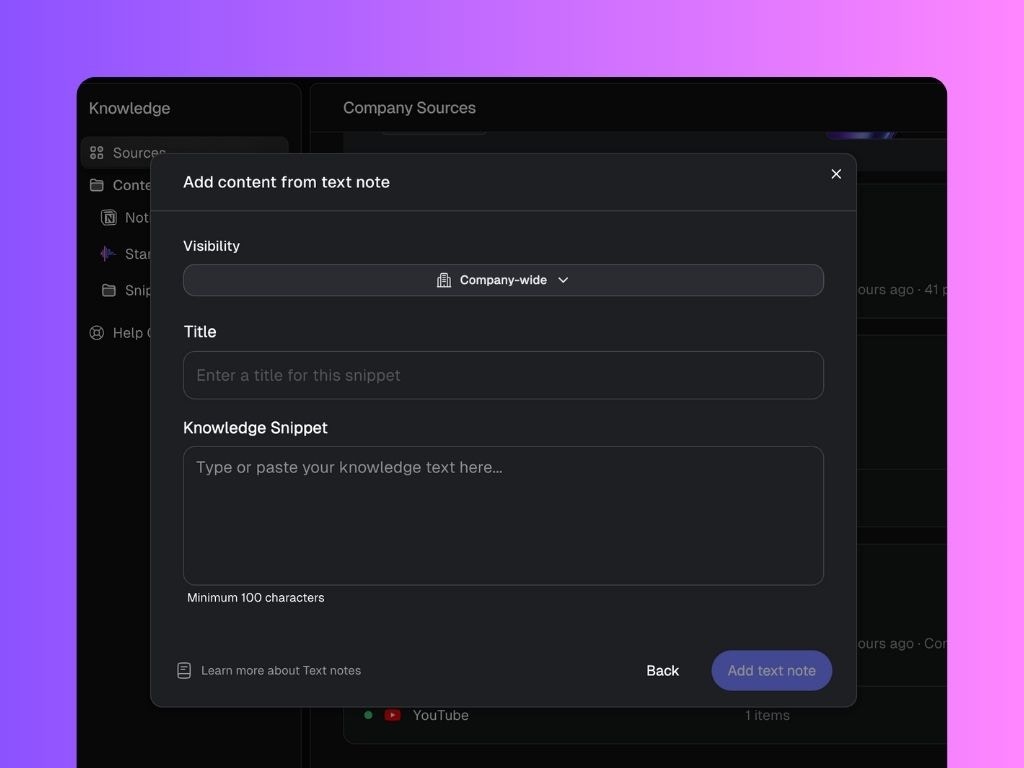
1. Text Notes
Text Notes are text-only entries that you add manually. They’re the easiest way to feed Scripe with context that doesn’t live in a file or online. Things like insights, experiences, or key information about you or your company. Use Text Notes for anything worth remembering or reusing in your content, from a personal story to your company’s core messaging. Here are some ideas to get you started:Personal Brand Level
- ✔️ A story about how you started your agency or key lessons learned
- ✔️ Notes from a podcast or book that shaped your thinking
- ✔️ Takeaways from a client project
Company Level
- ✔️ Company elevator pitch or boilerplate
- ✔️ Ideal Customer Profile (ICP) description
- ✔️ List of tools, SOPs, or frameworks
2. Documents
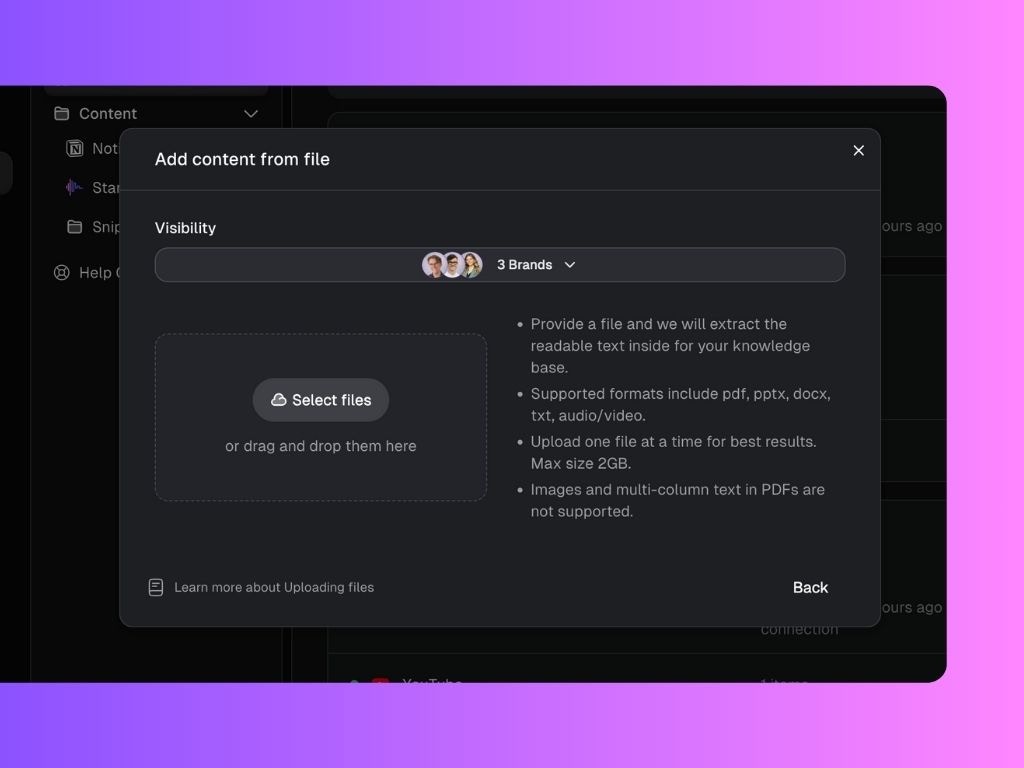
Documents let you upload files that contain written knowledge, such as case studies, presentations, or strategy decks. Scripe automatically reads and extracts the text from each file, turning your existing materials into a usable source of truth. Use Documents to store and reference things like:Personal Brand Level
- ✔️ A personal presentation or training deck you created
- ✔️ A PDF version of a client case study
- ✔️ A conference talk outline or workshop notes
Company Level
- ✔️ Sales decks and product one-pagers
- ✔️ Customer success stories or whitepapers
- ✔️ GTM playbooks, onboarding guides, or sales enablement docs
3. Websites
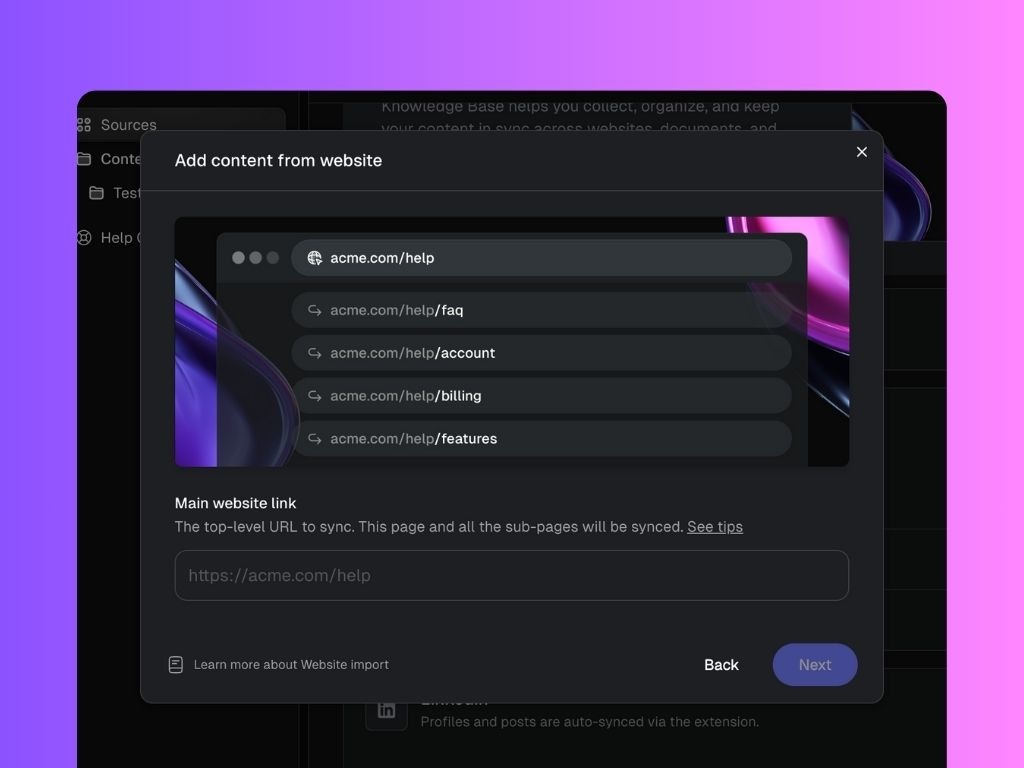
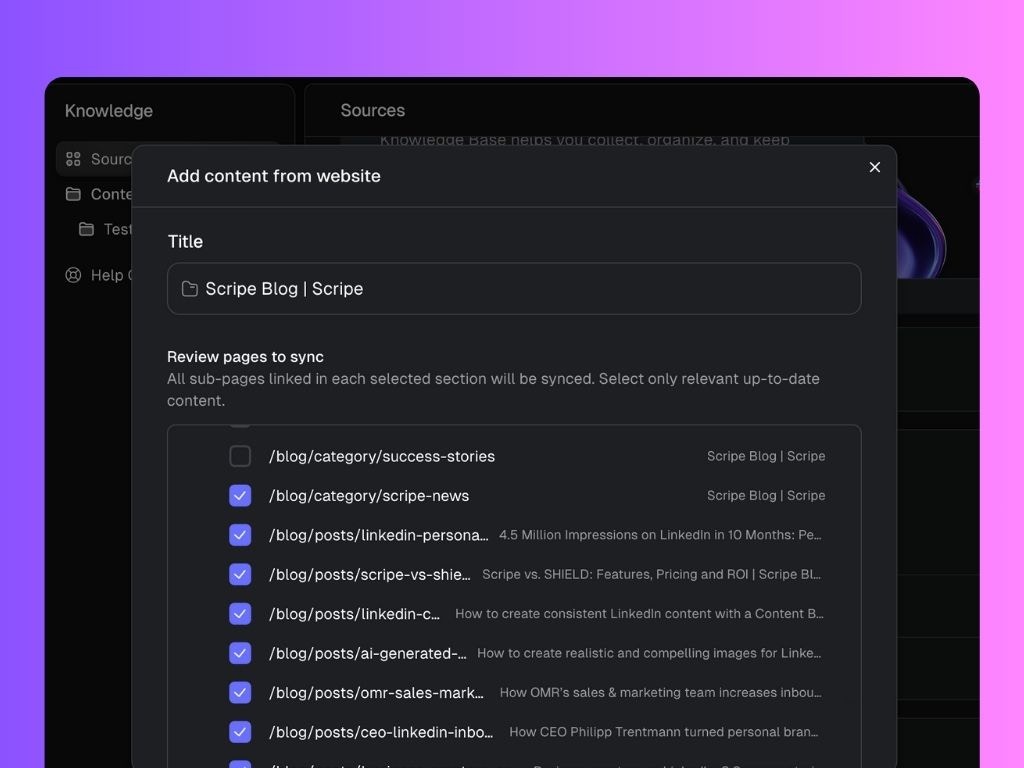
Connect any public website so Scripe can read its content. This is ideal for pages that already reflect your expertise, brand story, or company information — such as blogs, press pages, or product sites. When you connect a website, Scripe automatically scans the text on the page and turns it into usable knowledge for content generation.Links are automatically re-checked every 7 days to keep your Knowledge Base up to date.
Personal Brand Level
- ✔️ Your personal blog or portfolio site
- ✔️ Guest articles on Medium or industry blogs
- ✔️ A press feature or “About Me” page
Company Level
- ✔️ Home, FAQ, or pricing pages
- ✔️ Blog or resources section
- ✔️ Press page or careers page
4. Notion
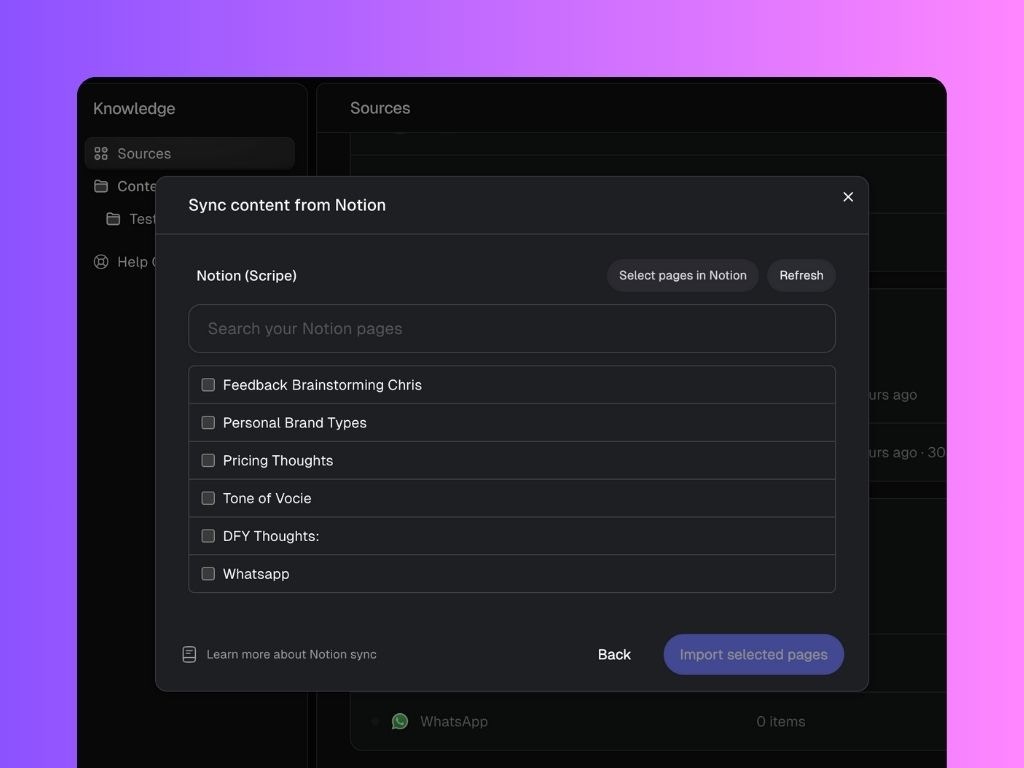
Connect your Notion account and select which pages Scripe should use as knowledge. By connecting your Notion account, you can sync selected pages directly into your Knowledge Base — perfect if you already use Notion to organize notes, playbooks, or documentation.To connect Notion to your Knowledge Base, click Connect Notion under External Sources. A popup will open for you to log in and grant access. Once connected, you can select which pages to sync, and Scripe will automatically add them as a folder in your Knowledge Base.
Personal Brand Level
- ✔️ A Notion page breaking down your personal workflow
- ✔️ A playbook you wrote (e.g., “How I run outbound with Clay and Smartlead”)
- ✔️ Notes or frameworks from personal experiments
Company Level
- ✔️ GTM strategy documentation
- ✔️ Process or SOP libraries
- ✔️ Product positioning pages
- ✔️ Typical customer pain points & challenges.
5. YouTube
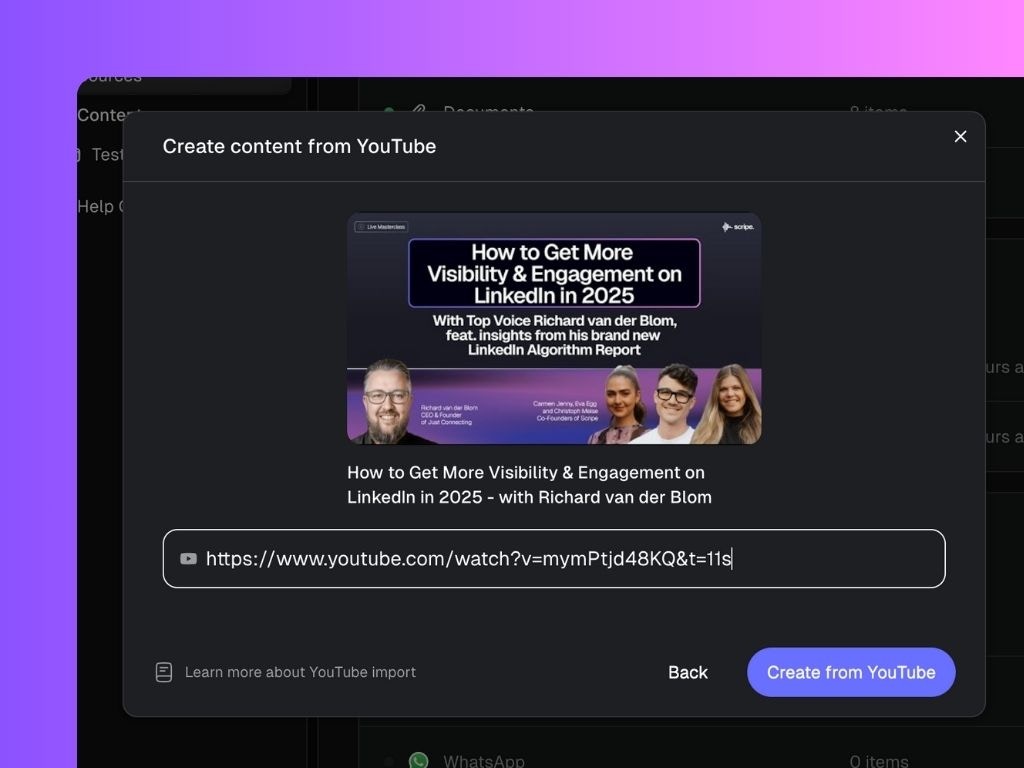
By adding links to YouTube videos, Scripe automatically pulls the transcript and turns the content into usable knowledge. This is especially helpful if you share your expertise through interviews, webinars, or tutorials. It allows Scripe to understand your natural way of explaining things and include that insight in your future content. Typical use cases for YouTube videos:Personal Brand Level
- ✔️ A podcast episode where you shared your founder story
- ✔️ A personal tutorial explaining a process you use
- ✔️ A keynote or workshop you hosted
Company Level
- ✔️ Webinars or product demos
- ✔️ Conference talks or customer interviews
- ✔️ Tutorials and feature walkthroughs
6. Automatic Sources (Personal Brand Level)
Besides the sources you set up yourself, Scripe also gathers knowledge automatically via:WhatsApp Connection
Anything you send to Scripe via your WhatsApp connection (messages or voice notes) will be added directly to your Knowledge Base. That way, your quick thoughts and ideas are always captured without extra steps.
LinkedIn Profile & Posts
Scripe automatically pulls in your LinkedIn profile and posts — including posts you made before using Scripe. This ensures your Knowledge Base reflects your full history, not just new content.
Control and Organization
To keep your Knowledge Base clean and easy to navigate, you can create folders and subfolders. This helps you group knowledge by themes or use cases.Note: When you connect Notion or add a Website as a source, Scripe automatically creates a folder for it in your Knowledge Base. This keeps external content organized right from the start.
Content added to the Company Knowledge Base in a company-wide setting is visible to all Personal Brands, so we recommend keeping it organized using folders.
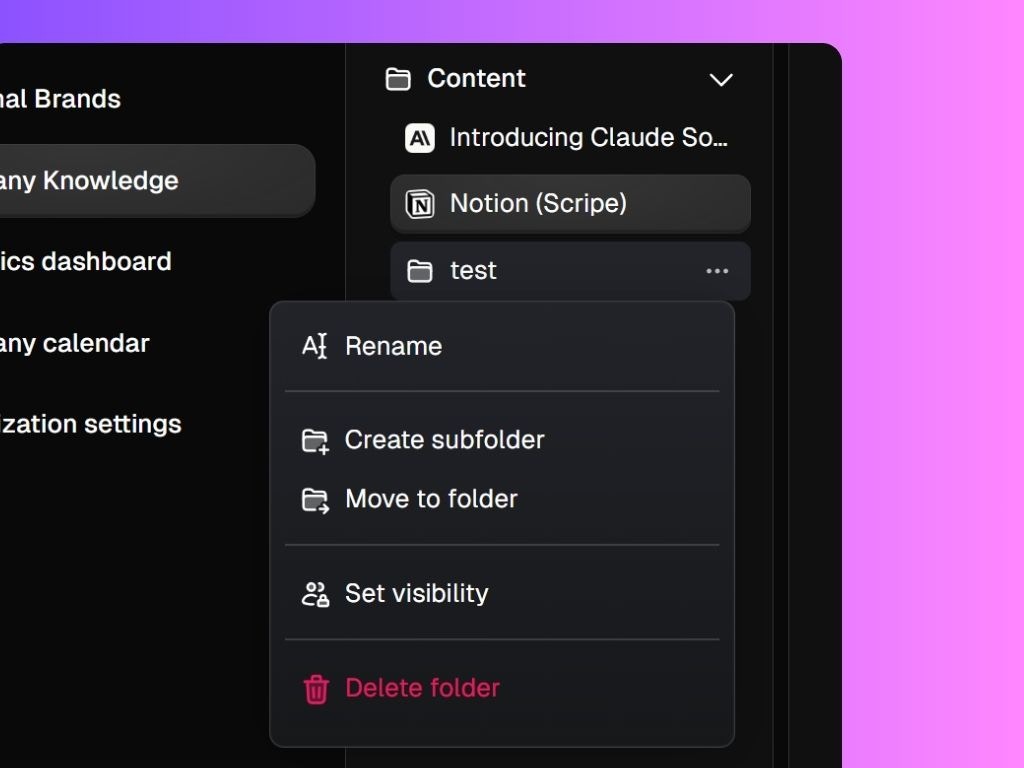
... , you can:
- Rename → update the folder name
- Create subfolder → add a layer of organization under a folder
- Move to folder → rearrange items into different folders
- Delete folder → remove it when no longer needed
Always Up to Date
- Websites you connect are automatically re-checked every 7 days to keep data fresh.
- LinkedIn sync includes both new and historical posts, so your full publishing history informs your Knowledge Base.
- WhatsApp inputs are captured instantly, turning quick messages or voice notes into usable knowledge.